


Wall Street Trims Guidance as Warsh Normalizes Policy | GS, AMP, SCHW, MS, RJF, SF, HOOD
October 1, 2026 | As the once torrid flow of new IPOs slows to a trickle, Wall Street firms that have benefitted from a huge surge of market activity over the past 18 months. Now Street firms must reposition for a decidedly less exciting environment and rising interest rates. Below we ponder the next steps for the Federal Open Market Committee and then, for subscribers to the Premium Service of The Institutional Risk Analyst, we set up the largest Wall Street investment banks for Q3 2026 earnings.
Time for Opportunistic Deflation?
We keep telling our readers that the past couple of years will long be remembered as one of the great bull markets in US history. Why? Because from 2024 onward through to the rate hike by the FOMC in September, credit spreads were falling and credit was expanding. When credit spreads fall, new financing activity goes up and markets and the economy surge. And all of this came about because the FOMC under Chairman Jerome Powell, again, panicked and provided fuel for higher inflation.
Lets review the recent history of Fed pump priming. The spreads for “BBB” credit were close to 150bp over the Treasury yield curve at the end of 2023, then rallied down to about 1% in mid-2024, but spiked in August. when the U.S. Bureau of Labor Statistics released a weaker-than-expected July non-farm payrolls report.
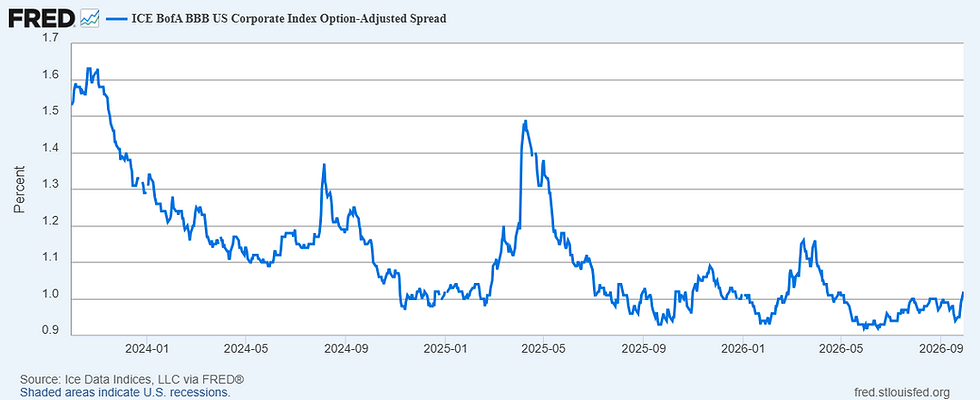
The unexpected jump in the U.S. unemployment rate triggered the "Sahm Rule," a historically accurate recession indicator, stoking intense fears among economists that the Federal Reserve had waited too long to cut interest rates and that the U.S. economy was headed for a hard landing. This turned out to be totally wrong and the Fed proceeded to do too much in response to a false indicator of recession.
As readers of The IRA know very well, the hard landing in 2024 never materialized and credit expenses for US banks have been falling for more than a year and a half. Yet despite the fact that the July 2024 jobs number was a false positive, the FOMC cut interest rates three times in 2H 2024 and three more times in 2H 2025, stoking an extraordinary rally on Wall Street that just happened to coincide with the peak of AI hype.
When we consider the track of interest rates during the term of President Donald Trump, it is hard to make the case that the Powell FOMC was not giving the White House everything they wanted and more. Now, however, the US central bank seems to be headed for a policy stance that is closer to neutral than accommodative, with real interest rates in positive territory.
There is no political tolerance in the 21st Century for the Fed to keep people out of work to bring inflation down a la Paul Volcker in the 1980s, but today inflation is so high that a stance of studied neutrality may be tolerable. If we recall the views of Philadelphia Fed President Edward Boehne in December 1989, when inflation was 4.5%, perhaps it’s time for some deflation.
Bill Nelson of Bank Policy Institute writes in his latest missive:
“The time is almost ripe for the Fed to adopt “opportunistic disinflation,” the strategy it followed in the first half of the 1990s. ‘Almost’ ripe because the Fed’s current tactic of moving the stance of policy to neutral is sensible. Doing so enhances Fed credibility on inflation and prevents it from feeding the irrational exuberance in financial markets. Two things set the stage for the approach: (1) inflation is modest and seems to be trending down, and (2) a slowdown or recession could be coming.”
Signs of a recession remain uneven, however, even though higher bond market yields are increasing pressure on private equity and credit portfolios. Analysis by Morningstar DBRS shows that 15% of actively rated private credit borrowers are receiving capital support or covenant relief, while the volume of firms looking to defer interest has nearly doubled to 6.8% in the past year.
Yet the economy remains far from a recession, in part because of the $2 trillion federal deficit. “The Commerce Department revised up its reading for gross domestic product in the second quarter to 2.2%, well above the 1.5% that had previously been reported,” Matt Grossman at the Wall Street Journal relates.
“Meanwhile, the inflation metric known as the personal-consumption expenditures price index rose by 3.4% over the past 12 months, the Commerce Department said in a separate report Wednesday, level from a month earlier.”
Of note, David Zervos will serve as counselor to Treasury Secretary Scott Bessent in a previously unreported move, says CNBC. Zervos joins after more than 15 years at Jefferies and years covering Fed policy and financial markets. The unannounced hire, which does not require Senate confirmation, is a rare piece of good news in a widening policy mess created by the Trump Administration since the start of the Iran war.
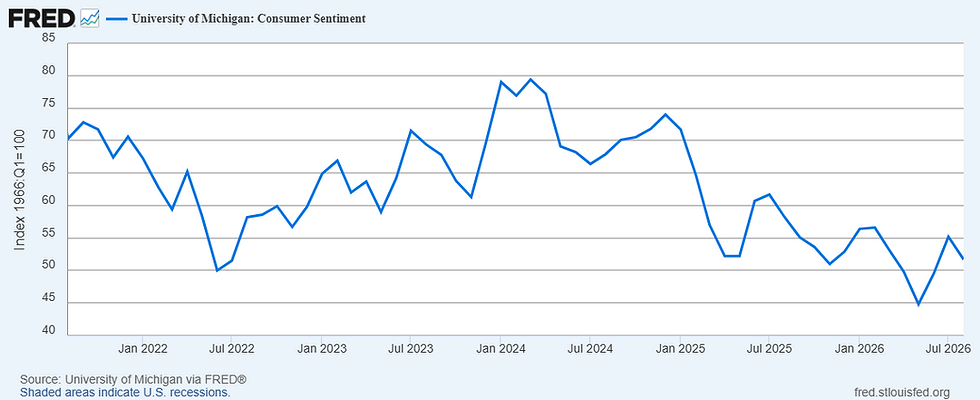
As the number of delayed IPOs grows, Wall Street firms are revising guidance downward due to shrinking backlogs and taking other steps to protect themselves from credit events. We noted in our comment about the major consumer lenders (“How Fast Will Consumer Credit Tank? | ALLY, AX, AXP, BCS, COF, HAPN, SOFI, SYF”), that the arithmetic of higher inflation will raise the levels of delinquency by a matter of simple mathematics. Politically, the fact of affordability as the chief political issue spells trouble for conservatives.
The Investment Banks
Below we provide a pre-earnings setup for the top investment banks, including Ameriprise Financial (AMP), Charles Schwab (SCHW), Goldman Sachs (GS), Morgan Stanley (MS), Raymond James (RJF) and Stifel Financial (SF). We also make reference to JPMorgan (JPM) and nonbanks Jefferies Financial Group (JEF) and Robinhood Markets, Inc. (HOOD).
Want to read more?
Subscribe to theinstitutionalriskanalyst.com to keep reading this exclusive post.


