Santander + Webster = ? | Affordability: Accelerate Treasury Debt Repurchases
Updated: Feb 9
February 9, 2026 | Last week, Adam Josephson published an interesting comment about the Treasury program to repurchase existing government securities. Why is the Treasury buying back existing notes and bonds, and issuing new debt, sometimes at a higher cost? For the same reason that caused the stock of PennyMac Financial (PFSI) to crater last week thanks to the MBS purchases by the GSEs, namely duration.
Few people in finance actually understand the bond market much less geeky subjects like option-adjusted duration (OAD), a key concept in the mortgage and asset management communities. You need to have friends like Alan Boyce, Fred Feldkamp, Lee Adler and Adam Quinones to beat you about the head and shoulders until you "get it." The famous Boyce napkin illustrating the value of mortgage servicing rights (MSRs) is below.

The Federal Open Market Committee under Chairman Jerome Powell frantically began to push interest rates down in January 2019 and began to buy trillions in low-coupon Treasury debt. By doing this, the Fed drained duration out of the market and thereby caused interest rates to fall. This also created a massive interest rate ghetto for dealers, banks and bond investors. The Fed’s ill-considered actions distorted the financial markets and also forced home prices up double digits.
Simply stated: The low-coupon bonds issued during COVID have a longer duration than current coupons with higher yields, making the Treasury market more volatile. A T-bill maturing tomorrow has a duration of one day, for example, but a 30-year zero coupon Treasury bond has a duration of 30-years and far greater volatility. Think of duration as a weight, pushing down on bond prices and raising bond market yields.
A new 30-year Treasury bond maturing in November 2055 with a 4.625% coupon, has a Macaulay duration of approximately 15 to 17 years. The 10-year Treasury note has a still high sensitivity to interest rate changes, aka volatility, but far less than the 30-year zero coupon Treasury debt or a mortgage-backed security with variable duration. The variability of duration in MBS caused Silicon Valley Bank to fail.
Dealers paying SOFR at 3.75% plus say 1-2% are not interested in holding Treasury debt or agency MBS or loans with coupons below 5%. While Treasury has purchased premium securities with higher coupons as part of repurchase operations, today the priority ought to be retiring COVID-era Treasury debt. Bonds with higher coupons trading at a premium to the market are more stable. The chart below from the FRBNY shows SOFR through last week.
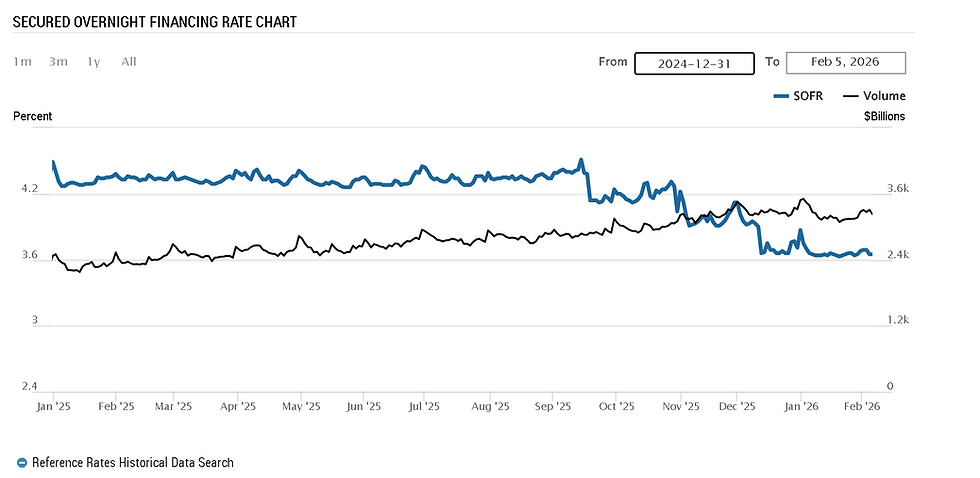
Source: FRBNY
Generally the Treasury’s repurchase of existing debt is limited by available cash. But when the Treasury repurchases a low-coupon bond issued during COVID at a discount and then issues a new bond at current rates, the agency actually generates net cash in the short-term but has a higher total cost over the life of the bond. Yet the bond market, investors and the Treasury itself benefit far more from repurchases of low coupon debt in terms of lower market volatility.
By repurchasing the low coupon securities, the Treasury also reverses the damage of the FOMC under Chairman Powell. As we’ve noted previously, the actions of the Powell FOMC merely continued the equally confused thinking of the Fed under Chair Janet Yellen (2014-2018). Yellen, Powell and their colleagues on the FOMC apparently thought that the central bank could control the long end of the yield curve. Wrong.
Of interest, the restart of net T-bill purchases by the FOMC for the system open market account (SOMA) in December is reducing the need for the Treasury to issue T-bills to the public. John Comiskey notes in Reverse Engineering Finance:
“Not only did Treasury leave the coupons alone this QRA but their forward guidance indicates continuing to do so for “at least the next several quarters”. Their mention of the SOMA Treasury bill purchases is also noteworthy. Treasury understands that those purchases will soon enough reduce Treasury’s need to issue bills (or coupons) to the rest of the public. The Fed indicated these purchases would slow down after April. How much they slow it will likely be a significant input to Treasury’s coupon levels calculus late this year.”
In The Wrap this past week (“The Wrap: Pulte Crushes PennyMac; Kevin Warsh's Conflict of Visions“), we noted that when the Fed’s balance sheet grows via open market purchases, bank deposits grow dollar-for-dollar, indirectly pushing up asset prices and inflation. Yet the political attraction of the Fed purchasing government is unavoidable, one reason we think that Warsh’s statements about shrinking the Fed balance sheet will ultimately be unrealized.
Treasury Debt as Tax Assets
The Treasury can accelerate the retirement of low-coupon, COVID era debt by taking a page from Argentina and treating all government obligations as tax assets. Last April we asked whether the Treasury ought to accept debt in payment of tariffs and/or taxes (“Should Treasury Accept Debt for Tax Payments? Bank OZK Update”).
Accepting tenders of Treasury debt at face amount for tariff or tax payments will supercharge the buyback process so as to eliminate all of the discount coupons in the government debt market. Doing so would lower market volatility and incentivize dealers and investors to hold the remaining paper, pushing market yields down. We wrote:
“High interest rates are a problem, but so too are low rate securities left over from COVID. Back in 2024, the US Treasury began a program to repurchase low coupon bonds in the open market in order to improve market liquidity. If you are a small dealer or fund paying SOFR +1% for money from your friendly neighborhood bank, you don’t want to own a Treasury note paying 0.125% per annum. More than half of the Treasury note market is more than 10 points under water at todays yields and therefore illiquid.”
It may seem counter-intuitive, but by removing the low coupon, high duration bonds from circulation, the Treasury can reduce the average duration of all public debt and thereby encourage LT interest rates to fall. Bonds with high coupons will be sought after by dealers and LT investors alike, pushing down Treasury yields and also interest rates for corporate debt and residential mortgages. Indeed, we think that the Treasury should adopt a standing policy to encourage investors to buy and redeem discount notes and bonds for tariff and/or tax payments.
The chart below shows the 323 issues of Treasury notes outstanding by coupon rate. The unweighted average coupon is 3% and the median coupon is ~ 3.5%. Yet the duration of the bonds below 3% coupons is much, much larger than the half of Treasury notes above 3% average coupon. The weight of the duration, if we think of it in physical terms depresses bond prices and forces yields higher.

Source: US Treasury
Fannie Mae and Freddie Mac have been repurchasing current coupons, for example, but they ought to focus their open market operations on low-coupon MBS. Trouble is, holding MBS with 2 and 3 percent coupons in portfolio will generate significant losses for the GSEs.
The Fed could to take all the $2 trillion in MBS in the SOMA and repackage the debt into collateralized mortgage obligations (CMOs). The Street can easily sell the Fed CMO bonds to insurers and pensions, and bury the duration forever. Doing so would actually help LT interest rates to fall. Indeed, the GSEs ought to do the same with MBS purchased to date. Issue CMOs, bury the duration.
Bottom line is that if President Trump wants LT interest rates and especially residential mortgage rates to fall, he should ramp up Treasury repurchases of low coupon government notes and bonds currently trading at a discount. Also, President Trump should direct FHFA Director Bill Pulte to restructure MBS purchased by the GSEs into CMOs of different maturities.
Banco Santander SA + Webster Bank = ?
Banco Santander SA (SAN) announced an agreement to acquire Webster Financial Corporation (WBS), the parent company of Webster Bank, in a deal announced on February 3, 2026. The transaction is valued at approximately $12.3 billion, a ~ 10% premium to WBS market cap prior to the announcement. The deal is expected to close in the second half of 2026, subject to regulatory and shareholder approvals. We suspect this deal will get approved quickly, one reason that you're likely to see more M&A transactions this year.
SAN is a dominant retail bank in the EU with over 178 million customers, although it ranks behind BNP Paribas and Crédit Agricole in terms of total assets. In the US, SAN operates through $175 billion asset Santander Holdings USA (SH USA), which owns $104 billion asset Santander Bank, N.A. (SBNA) and Santander Consumer USA (SC). Below we provide our specific thoughts on the transaction for subscribers to our "Premium Service."

Want to read more?
Subscribe to theinstitutionalriskanalyst.com to keep reading this exclusive post.