


Mortgage Notes: Falling Volumes, Rising Defaults; Will UWMC Survive?
October 14, 2026 | In this edition of The Institutional Risk Analyst, we return to the world of mortgage finance after spending two informative days at the MBA Annual in Chicago. The good news is that mortgage bankers, as always, remain upbeat about the housing market and the economy. The bad news is that most of the attendees know that the industry is facing a double digit decline in business volumes, rising delinquency and will be continuing to shed headcount as the year grinds to a close.
One question that we hear a lot from mortgage bankers is about interest rates. As we noted in our conversation with Joe Costello (“Joe Costello on Top Down Democracy; WGA Precious Metals Top 25”), with the Fed no longer buying bonds via “quantitative easing” or QE, yields must rise. In round numbers, the Fed bought $10 trillion in Treasury debt and MBS from 2008 through COVID. The chart below shows the system open market account (SOMA). The red line is holdings of US Treasury securities and the green line is mortgage backed securities.
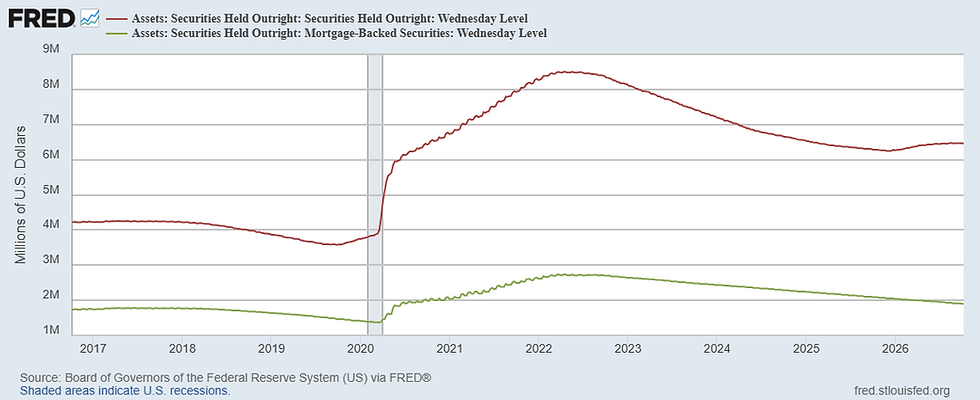
"The CBOT Bond future is negatively convex such that a further rate rise could create the equivalent of Scott Bessent selling $110 Billion twenty-year bonds into the market," notes Harley Bassman of the Convexity Maven. "Most bond investors are familiar with the Negative Convexity of Mortgage bonds (MBS), but I suspect many buyers of US Treasuries via the futures market do not fully appreciate this risk."
Another related question that we have also heard about from our readers is the impact of rising interest rates on banks. Total unrealized losses on non-equity securities held by banks peaked at $516 billion in Q1 2024 and has declined since then to $325 billion in Q1, but the unrealized losses have started to rise again in Q2 2026. Given the move in the bond market, we’d assume that unrealized losses will be higher in Q3 2026.
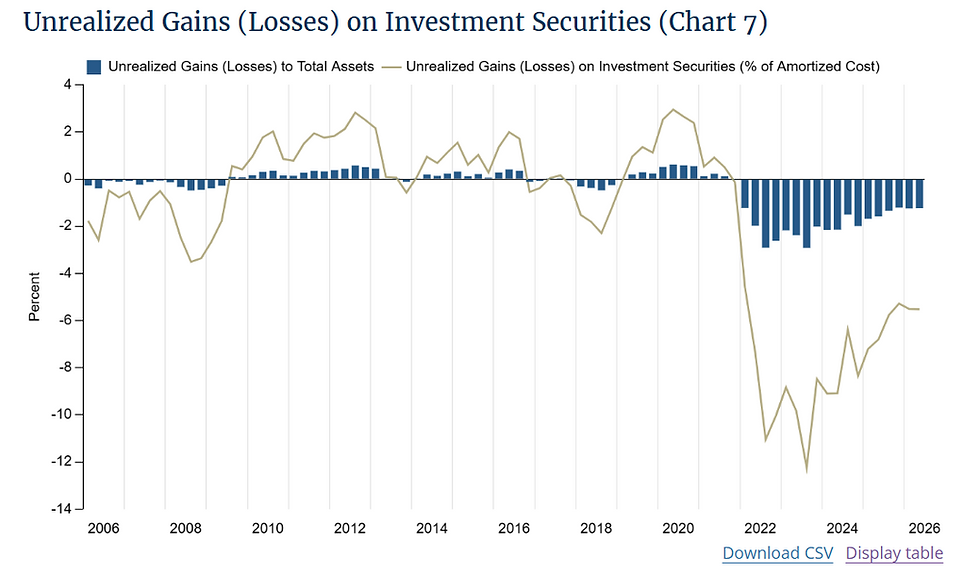
Source: FDIC
Rising interest rates are also having a negative impact on mortgage volumes, causing analysts to lower estimates for future lending activity. Some observers are expecting a large reset in home prices, but our friend Stan Middleman, founder of Freedom Mortgage, now says that higher interest rates and inflation are likely to keep prices for homes and other assets flat for an extended period.
That’s right. Stan no longer sees a housing reset in 2028, mostly due to higher inflation from the Iran war, but instead sees housing and asset prices moving sideways until the FOMC moves to drop interest rates. Of note, MBA chief economist Mike Fratantoni had this to say about home prices at the press briefing:
“We are worlds different from where we were a couple of years ago in terms of supply conditions, where we now have 10 months of supply in the new home side, approaching 5 months of supply in the existing side, time in the market is the same thing. So it really is, at best, a balanced market and more of a buyer's market naturally. When I look at particularly sort of top-level home prices, we've had two patterns in the past, right? One would be home prices run up, and then you have a long period of time where home prices are flat as incomes catch up. I think that's the most likely path that we're on. And then you have a significant correction to get them more in line with pricing. And I think that's what we experienced through the financial crisis. I don't think that's a likely outcome here, but that's the other way you get valuations to correct. But I think the most likely path is instead you have a long period of time where all prices are stagnant and incomes are rising fast.”
The Mortgage Bankers Association research team is projecting a modest decrease in home prices in 2027 through 2029, again confirming the perspective of Freedom's Stan Middleman. The chart below shows the latest projections from the MBA.
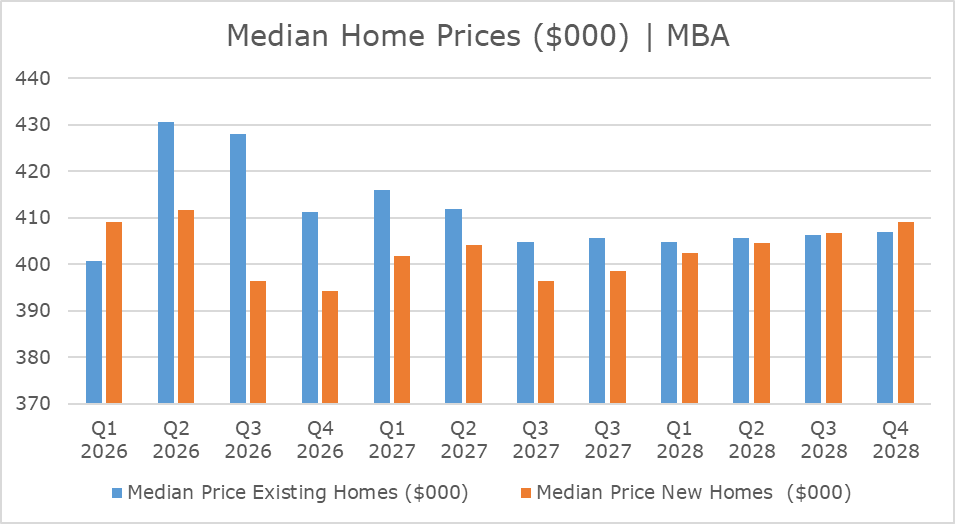
Source: Mortgage Bankers Association
The rate on 30-year fixed rate mortgages fell last week, proving yet again that lenders set mortgage coupons and markets set bond yields. But bond yields are going higher because of the war with Iran ℅ President Donald Trump and Israeli PM Benjamin Netanyahu, a conflict that will drive inflation into double digits this year.
Primary-Secondary spreads bottomed in January of this year, when most issuers were expecting lower interest rates. Bond spreads are widening as a result of the Iran war and absurd actions and statements by the Trump Administration. The economic and political consequences of these many acts of stupidity will be felt for many years to come. The chart below from FRED shows the yield on 30-year fixed rate mortgages from Freddie Mac less the yield on the 10-year Treasury note.

We suspect that a future decrease in the suggested target for federal funds may not be enough to push down long-term interest rates. The Fed may be forced to return to QE, perhaps after a market “surprise” tied to the incestuous behavior fueling the growing AI bubble.
Many AI companies in and outside the mortgage market raise private money at absurd valuations, then require the private equity investors to purchase AI services from the same company. This is the same circular, Ponzi-style finance that has been pioneered by Nvidia (NVDA). Billionaire hedge fund manager Paul Tudor Jones has warned that AI-related debt and spending could push financial markets to a breaking point.
FASB Proposal on MSRs
Another interesting topic of discussion at the MBA Annual was the proposal by the Financial Accounting Standards Board (FASB). which is considering an update to US accounting rules that would specify that an entity should include the value attributable to the potential recapture of a borrower through the extension of a new loan when measuring the value of the right to service a residential mortgage loan.
The FASB proposal was reportedly pushed by PennyMac Financial (PFSI) and Rithm Capital (RITM), who want to see higher valuations for MSRs to help them maximize liquidity, especially in a declining loan market. But on the other side of this issue are the largest banks, who vehemently oppose the FASB proposal and say that any increase in the fair value of MSRs due to the inclusion of speculative estimates of recapture will be met with lower lending thresholds.
We hear that during a conference call sponsored by the MBA, one of the four largest banks went completely irate over the FASB proposal and made it very clear that they will not tolerate any support for the proposal by the trade group. One bank that was on the same call said that it is “extremely unlikely” that the MBA or other mortgage trades will publicly support the FASB proposal and that the change will have no impact on investor valuations.
“At the end of the day, the valuation of an MSR is about duration, not some speculative estimate of possible recapture,” one veteran mortgage banker told The IRA. “All of this fuss about recapture will have no impact on what investors are actually willing to pay for an MSR.”
The same source notes that purchase mortgages are extremely difficult to retain, but customers who refinance mortgages tend to stay with their existing lender. Purchase mortgages are currently 75% of total volumes, thus recapture rates are likely to undershoot the inflated estimates used by auditors.
Under GAAP, the job of an auditor is to determine what a willing buyer would pay for the MSRs, not necessarily what they're worth to the current servicer. That means that auditors can't base recapture assumptions on how successful a particular servicer has been at retaining borrowers. Investors with no interest in recapture will be indifferent to the adjustment and lenders, at best, are likely to ignore any increase in fair value blessed by the FASB.
DSCR Sector Rolls Over
One of the key revelations that we heard at the MBA Annual was confirmation of our earlier report that business purpose loans for rental properties are likely to be a considerable source of problems for the industry (“Mortgage Notes: Desperately Selling DSCR; Can UWMC Pivot to Stability?”).
Roughly 30% of all non-qualified loans are debt service coverage ratio (DSCR) loans and the pricing for these assets is rapidly falling as lenders become concerned about credit quality. Several bankers at the MBA Annual told The IRA that credit is likely to deteriorate rapidly as the year ends.
“We started at 120% debt service coverage for DSCR loans, then we dropped to 115% and 110%, and now we are seeing loans at 100% or lower,” notes a veteran warehouse banker who has cut off several lenders in recent weeks. “Some DSCR issuers are surprised that lender valuations have fallen from 102 down to well below par.”

The hidden risk with DSCR loans is that these are commercial loans, so your typical residential loan servicer has no idea how to resolve delinquencies. The non-QM loan securitizations that often contain an ample portion of DSCR loans are typically serviced by mainstream residential mortgage firms, who generally lack the personnel and experience to resolve a defaulted business loan. Hint: confession of judgement.
According to S&P Global Ratings, delinquency and impairment levels among Debt Service Coverage Ratio and non-qualified mortgage (non-QM) loans have been rising due to higher interest rates and tighter vintage performance, though overall loss severities remain contained – for now. The levels of fraud in DSCR loans are significantly higher than traditional residential mortgages.
“Non-QM rate-lock volume rose 8% from August, according to Optimal Blue’s September Market Advantage report, even while total lock volume fell 2.1% month over month and 26.1% from a year earlier,” National Mortgage Professional reports. The bubble in DSCR and non-QM loans continues to expand even as the broader market retreats. As and when banks start to pull back from the non-QM market, a considerable rout will result.
Is there a Bull Case for United Wholesale Mortgage?
We predicted the collapse of United Wholesale Mortgage (UWMC) last year when we noted that the firm was running an operating deficit and CEO Mat Ishbia was selling mortgage servicing rights (MSRs) below cost to raise cash. This unsustainable business model ultimately forced the largest lender in the US to seek a $1.65 billion financial rescue from Oaktree Management.
Want to read more?
Subscribe to theinstitutionalriskanalyst.com to keep reading this exclusive post.


