


Jim Rickards: False Narratives in AI & Crypto and the Case for Gold
December 3, 2025 | In this issue of The Institutional Risk Analyst, we feature a conversation with a long-time friend and fellow Lotosian James G. Rickards. We last spoke with Jim in 2024 when he was just releasing his latest book “MoneyGPT: AI and the Threat to the Global Economy.” Of note, Jim will be speaking to a members-only gathering at The Lotos Club of New York in January 2026. Following the event, Julia LaRoche and The IRA editor Christopher Whalen will host a discussion with Jim. And a reminder, the quarterly conference call with subscribers to the Premium Service of The IRA will be this Thursday at 10:00 AM.
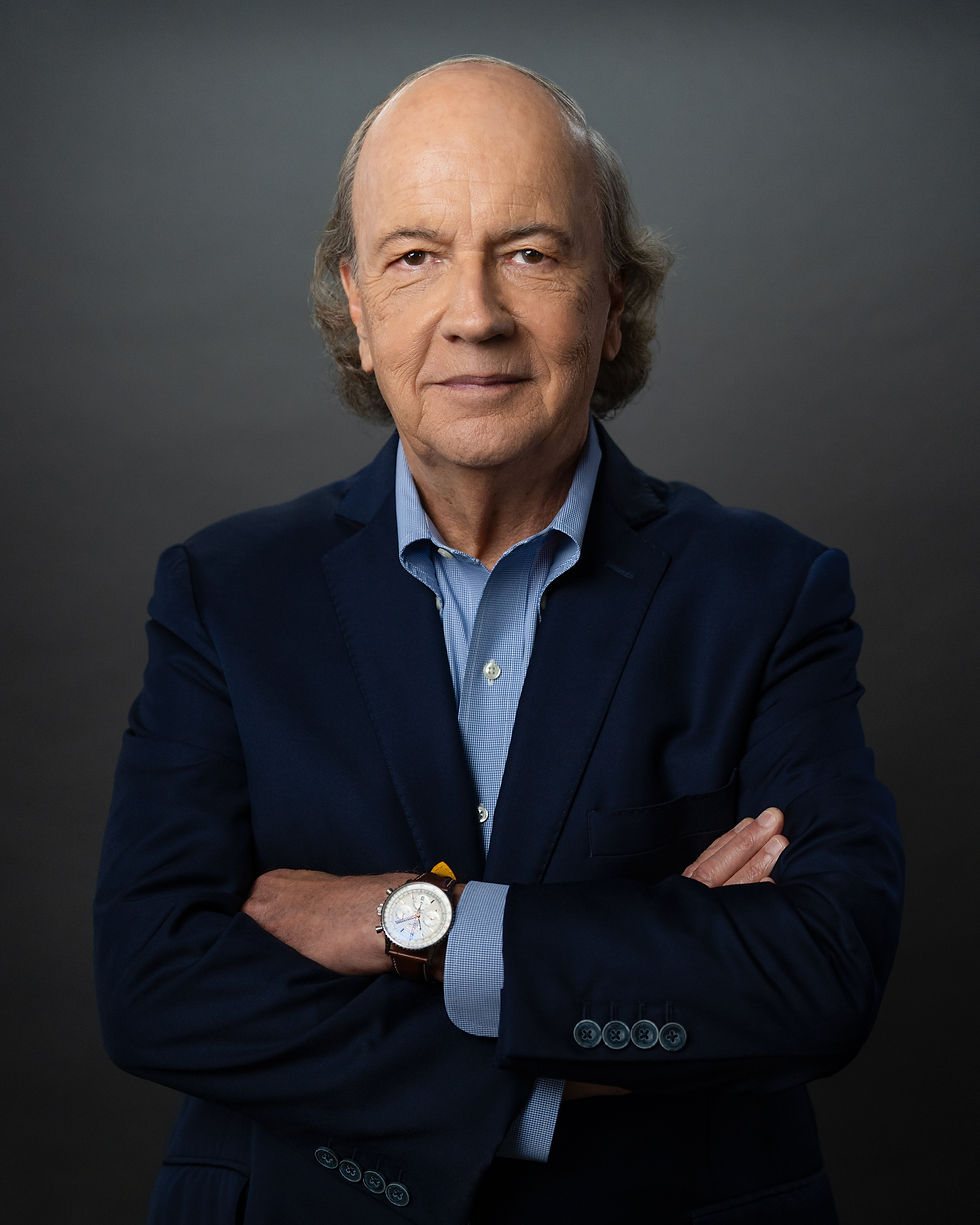
James Rickards
The IRA: Jim, let’s begin with AI and the crypto mess. The Financial Times just carried a fascinating article that said that global insurers are unwilling to cover AI because it has too many errors.
Rickards: Well, there's that, and I could go on, but I think that's the smart move by the insurers. You can't underwrite a risk if you don't understand it.
The IRA: Our view is that AI is fine for consumers. We'll have a lot of fun with these tools. But for the enterprise, if it's not pretty close to perfect, you can't roll it out because somebody is going to turn around and sue you. And I think that's really what the insurers are saying. Many of our colleagues working in the mortgage and consumer credit industry confirm this view. AI tools cannot be made operational unless they are nearly perfect and most of AI is miles away from perfection.
Rickards: Well, that may be, and that would be a smart thing to say. I would go a lot further, of course, you know. In my ChatGPT book, I talk about this question and recall my discussions with Gilman Louie, who was the CEO of In-Q-Tel, which is the CIA's venture capital firm. He said, 'Jim, what's behind the curtain is way more powerful and indeed frightening than what we know about.’ There are legitimate concerns about what we already know about. What people are worried about in AI already exists. These more powerful AI tools are being held back behind a curtain because the creators are afraid themselves. They don't think the guardrails are in place, the governance, anything, and they don't even know how these AI tools will behave. So, they're holding these tools back. So, those kinds of concerns are not in the future. They're real and they're here and now.
The IRA: So you mean we may actually have something that's smart enough to drive the Waymo self-driving car around San Francisco without killing the cat?
Rickards: Well, or smart enough to start World War III. That's the problem.
The IRA: How have you reacted to the recent sell-off in crypto? Were you kind of expecting this sort of rout as we were?
Rickards: It’s funny. People think I'm technophobic. It's not true. I read that Satoshi Nakamoto paper in 2009. But I've been in like eight or nine gold versus bitcoin debates. And I won each time. I took the side of gold and I won every single debate until about two weeks ago in Nashville. It was me and James Altucher. And James was taking the side of bitcoin. I was for gold. We had a large audience, about 700 people. And it was refereed, all fair. And I lost. And I said to myself, 'That's the top.' I said, 'If I lost this debate, if my pro-gold audience votes for bitcoin, that's a top for bitcoin.' And since then, it's down 25%, 30%. And gold's flattish, but not down at all. Maybe up a little bit. So, the answer is no— the selloff in bitcoin did not come as a surprise. In fact, the minute I lost the debate, I said, 'that's got to be a top because this is not a bitcoin crowd.' And it was an older demographic. They were 60, 70 years old. They were there because they like gold, among other reasons. I said, 'if they've gone around the bend for bitcoin, then there must be no investors left who aren't already in.'
The IRA: Or put another way, the smart money is already out. We did a piece about before Thanksgiving called “Wall Street Killed bitcoin.” And we quoted our friend Michael Green at Simplify, who is one of the more educated, erudite people on Wall Street. And, you know, to your point, when you have... these ETFs and other things spreading and you have such broad uptake, it has to signal that kind of the bloom is off the rose, at least from the early days, don't you think?
Rickards: Yes. Leaving aside the issue of what bitcoin is, and again, blockchain has been around since the 80s. I understood the applied mathematics. I got it. It was a good illustration of the fact that really good applied mathematicians don't know anything about money, but that's a separate issue. I understood exactly how it worked— what it does, you know, and why, etc. But I never could quite figure out what bitcoin is. I mean, it's a couple electrons. I get that. But what is it? And it took me a very long time. And I finally came to understand what it is. You know, it's kind of an extended metaphor.
The IRA: Bitcoin is an option to take advantage of a greater fool. The latest version of the oldest story, namely human greed. The hard-wired propensity to chase the shiny object that exists inside all humans. As put most succinctly by Friedrich Nietzsche, “Madness is rare in the individual—but with groups, parties, peoples, and ages it is the rule.”
Rickards: But around that, leaving what it is, okay, that's a core issue. The proponents of bitcoin have replicated the entire ecosystem of Wall Street, you have custodians, you have clearance firms, you have exchanges, you have derivatives, you know, et cetera. They basically took everything that's taken— four or five hundred years of experience to create around Wall Street and duplicated it around crypto – but with one difference, which is there's no regulation. There's no FDIC and there's no lender of last resort. So, you have basically set yourself up for failure. Pick the crisis; 1869, 1907, 1929, 2008. Take all the great financial panics. We've set ourselves up for that with no safety net, because the reason the safety net exists was because of all those prior failures.
The IRA: Right. But, you know, the crowd pushing crypto explicitly decided we don't want to be a security. We think that was a major miscalculation. And yet today bitcoin is correlated to the securities market because of perpetual futures and ETFs. They're kind of captive now to the narrative of Wall Street. Some of the bitcoin ETFs have been annihilated in the past few weeks.
Rickards: You're exactly right. And a lot of people are looking at correlations of statistics and standard deviations and all that stuff, which I don't have much time for. To me, the way you understand things like bitcoin is through behavioral psychology. The power of the narrative is huge. Wall Street pumps out narratives because they need a story to sell your stocks. Most of the narratives are just wrong. You can demonstrate that, but it doesn't matter. People believe it. You get into the self-fulfilling prophecy. If enough people believe the narrative, the narrative becomes true. Not because it's fundamentally true, but because people behave in accordance with the narrative. So the narrative now is that bitcoin is correlated to Nasdaq. Good luck with that.
The IRA: But that's precisely the thing we worry about. If you look at the demographics that you and I have followed for years, we're on the other side of the slope heading down. Doesn't this imply that the easy days of pump and dump and narrative building are behind us? Are manufactured narratives such as NVIDIA, obviously, vis-a-vis AI, going to be more difficult? Or are false narratives from Wall Street just a built-in thing in the marketing system? And we'll just have a next phase of marketing hype by next year?
Rickards: No, I definitely think we're at an inflection point. I hate to use clichés, but that's one that is appropriate here. People forget the Dow Jones hit 1,000 in 1969. It then went down to like 300 and didn't get back to 1,000 again until 1983. That was 14 years in the wilderness. Now, there were ups and downs. I'm not saying you couldn't make or lose money in the stock market. You could. But it never got back to 1,000 for 14 years. Then, when you adjust for inflation, the thousand was only 500.
The IRA: Inflation is one of the greatest problems of using time series data to illustrate economic trends. Look at the US banks. Balance sheets have more than doubled since 2008. You really need to inflation-adjust statistics to avoid the greatest cognitive illusion, namely the inflation trap.
Richards: Right. In real terms, because we have 50% inflation, 5-0 from 1977 to 1981. So, so in real terms, you weren't even back to a thousand on the Dow in 1983; it was only nominal. That's what a bear market looks like. But that's 14 years without making any money or actually losing quite a bit of money. So, we could be in for something like that where it doesn't have to be 1929 or 2008 all over again. It can just be 15 years of no or few real returns.
The IRA: Exactly. The strength of America, don't you think, is the fact that we're always willing to get back into the game. After COVID, for example, the US bond market came back almost immediately. And yet these false narratives with crypto and AI on the financial market side are deviating dramatically vis-a-vis gold. In fact, gold has been pretty stable in this sell-off. We don't think selling gold is really that good of an idea, given the demand characteristics in the market. How do you view it?

Rickards: So gold went basically from $2,000 to $4,000 an ounce, almost in the blink of an eye, two years maybe, but that's after going more or less sideways since 2011. With the prior peak in 2011, gold peaked at $1,900, just a little bit shy of $2,000. It then fell 50%. And hit an interim low in 2015, December 2015. Right? So, it was a four-year bear market. And it's been coming back ever since. But most of the period— from 2015 to 2022, or give or take— it was 1,300, 1,400, 1,800, back down to 1,200. Again, you can make or lose money, but it was in kind of a broad range, but not a very broad range. And then boom! So now here we are at 4,000.
The IRA: The move to $4,000 was driven by a lot of changes going on in the background, central bank buying and also the increases in the US debt.
Rickards: Yes and all the people who were like, 'Look at gold! It's amazing! It's incredible! I'm, like, this is just noise. The fact is, saying that gold's going to $10,000 an ounce now is almost a cliche. I mean, it is. But everyone's saying that. It's funny, when I started... as kind of as a public voice on gold around 2012, there were a bunch of people advocating gold who had this space. I was probably older than some of them, but I was the new kid on the block. Anyway, when gold crashed after 2011, they all disappeared. And I kept going. I kept writing my book, The New Case for Gold. I kept talking. And these guys went away. And then some of them reemerged as crypto bulls. But this would be my value-added forecast. Gold is going to go to $10,000 a lot faster than people realize, a lot faster than people think. And the reason is, again, behavioral psychology.
The IRA: Do tell.
Rickards: So there's a phenomenon called anchoring. And anchoring is a cognitive bias. And basically, we get a number in our head, or we get an idea in our head, and we anchor on it. That's our safety zone. But then we filter all the incoming information. We filter through that anchor. There are, like, 100 cognitive biases, but that's a powerful one. And so, people say, well, if you have 50 ounces and it goes up $1,000 an ounce, you just made $50,000. And that's true. And it goes up another $1,000 an ounce. You just made another $50,000. And that's true. And we've had a couple of those milestones in the last couple of years. People get anchored on the $1,000 and the $50,000, but what they don't realize, this is fifth-grade math, is that each $1,000 hurdle is easier than the one before because you're working off a higher base. So, as a percentage gain, it's much easier. So going from 3,000 to 4,000 is a 33% gain, that's a heavy lift. But going from 9,000 to 10,000 is an 11% gain, which is like a good month. So my point is: Yeah, we're going to take a while to get to 5,000 and then 6,000. But you're going to go 7, 8, 9, 10 really fast because they're just easier milestones because each one is a smaller percentage gain than the one before. And so people who... watch gold go from 2, 000 to 3,000, 3,400, like man that was yeah nice going but that was a long haul. And they extrapolate that without stopping to think that it actually gets easier and faster.
The IRA: Well, it's very similar to the progression of bitcoin. If you had been in early on, in 2009, it had some of its best gains in the first few years. And from then on, it was diminishing returns, even though impressive. What you've just described makes me think about some of the doom and gloom voices who are either all into bitcoin or also all into gold. Talking about how there's going to be this sudden apocalyptic collapse of the US dollar and the economy. And I keep looking at them and I say, no, no, it's just going to change. We'll have more gold, but the fiat system in all of these countries that are now buying gold for reserves is going to continue. They have no choice, right?

The Financial Times
August 15, 2025
Rickards: That's right. Your analysis is exactly right, Chris. You just have to take a breather and say, 'Wait a second.' Let's deconstruct that a little bit. There are charts flying around from different services and they show that gold as a percentage of total reserves and then dollar denominator securities as a percentage of total reserves. And they just crossed for the first time in some time, decades or maybe longer. Gold is a higher percentage than dollar denominator securities. And everyone's like, 'Well, this proves that—' Countries are dumping treasuries and buying gold. No, it doesn't. I mean, central banks are buying gold, but it doesn't prove anything. It's because the price went up. You don't need any more gold. If your numeraire is the US dollar and you're computing dollars as a percentage of the total, then the mere fact that the price of gold went up is going to increase that percentage, even if you didn't buy an ounce.
The IRA: Correct, but isn’t the major change the level of gold buying by global central banks even if they are not sellers of dollar securities? The Chinese don’t earn any income on the gold sitting in a vault in Beijing.
Rickards: From an investment trading point of view, gold is what I call an asymmetric trade, which is the central banks are net buyers. From 1970 to 2010, central banks were net sellers of gold every single year. Beginning in 2010, they've been net buyers every single year. Now, different central banks, not all the same players. Some are in, some are out. On the whole, they've been net buyers ever since, and that's going to continue. And this is what, for people who want to go back and look at my book, Currency Wars, which came out in 2011, but I described a financial war game that I facilitated in 2009 where Russia and China would come up with a new... currency backed by gold.
The IRA: But neither Russia nor China have tried to create a new global currency. Russia had about 600 metric tons, and China had about 600 metric tons. Today, Russia has about 2,500 metric tons. And China has about 2,900 metric tons. That they admit, odds are China has perhaps doubled that off the books in the State Administration of Foreign Exchange (SAFE). In other words, Russia and China did exactly what we told the Pentagon they were going to do in 2009. Although, you know, here we are, what, 16 years later.
The IRA: What do you expect in terms of official buying of gold?
Rickards: Well, it’s going to continue. And central banks are actually very smart buyers. I hate to say, you know, they buy the dips, but they kind of buy the dips. In other words, if you were buying gold and you weren't done. You actually don't want the price to go up that much because you want to keep buying. It's going to go up eventually. Yeah, if you're still in the market you're happy with a lower price, but above all, they don't want to disrupt the market. Nobody did this better than Russia. Russia had standing orders with the banks of London. It's like you know, 10 to 30 tons a month. You know, don't disrupt the market. Buy the dips.
The IRA: We did an interview earlier this year with Henry Smyth, who runs a gold fund in the Bahamas. In 2011 when you became an advocate of gold, he tried to get managers to increase allocations. He did not get much of a reception, but like you he stayed focused on the long-term value proposition and had done very well for his clients.
Rickards: But all of this means is, from an investor's point of view, is that the central banks kind of have your back. They're not going away. And so, there's limited downside. An unlimited upside. Because there is a long list of things that could drive the price of gold up a lot higher. Not necessarily central bank buying, but, you know, pandemic, social unrest, civil war, another war in Ukraine. A natural disaster. So, when you have a trade where you have limited downside and unlimited upside, that's my favorite kind of trade.
The IRA: Thanks Jim. See you in January at Lotos.


The Institutional Risk Analyst (ISSN 2692-1812) is published by Whalen Global Advisors LLC and is provided for general informational purposes only and is not intended for trading purposes or financial advice. By making use of The Institutional Risk Analyst web site and content, the recipient thereof acknowledges and agrees to our copyright and the matters set forth below in this disclaimer. Whalen Global Advisors LLC makes no representation or warranty (express or implied) regarding the adequacy, accuracy or completeness of any information in The Institutional Risk Analyst. Information contained herein is obtained from public and private sources deemed reliable. Any analysis or statements contained in The Institutional Risk Analyst are preliminary and are not intended to be complete, and such information is qualified in its entirety. Any opinions or estimates contained in The Institutional Risk Analyst represent the judgment of Whalen Global Advisors LLC at this time, and is subject to change without notice. The Institutional Risk Analyst is not an offer to sell, or a solicitation of an offer to buy, any securities or instruments named or described herein. The Institutional Risk Analyst is not intended to provide, and must not be relied on for, accounting, legal, regulatory, tax, business, financial or related advice or investment recommendations. Whalen Global Advisors LLC is not acting as fiduciary or advisor with respect to the information contained herein. You must consult with your own advisors as to the legal, regulatory, tax, business, financial, investment and other aspects of the subjects addressed in The Institutional Risk Analyst. Interested parties are advised to contact Whalen Global Advisors LLC for more information.


Comments